Preliminary Visual Analysis of Generative Models prompted to generate FDTD Simulations
Original Code and Author:
2D Water Ripples
The Coding Train / Daniel Shiffman
https://thecodingtrain.com/CodingChallenges/102-2d-water-ripple.html
https://youtu.be/BZUdGqeOD0w
https://editor.p5js.org/codingtrain/sketches/tYXtzNSl
Modified to highlight and illustrate sources and serves a training tool to understand a full FDTD solver.
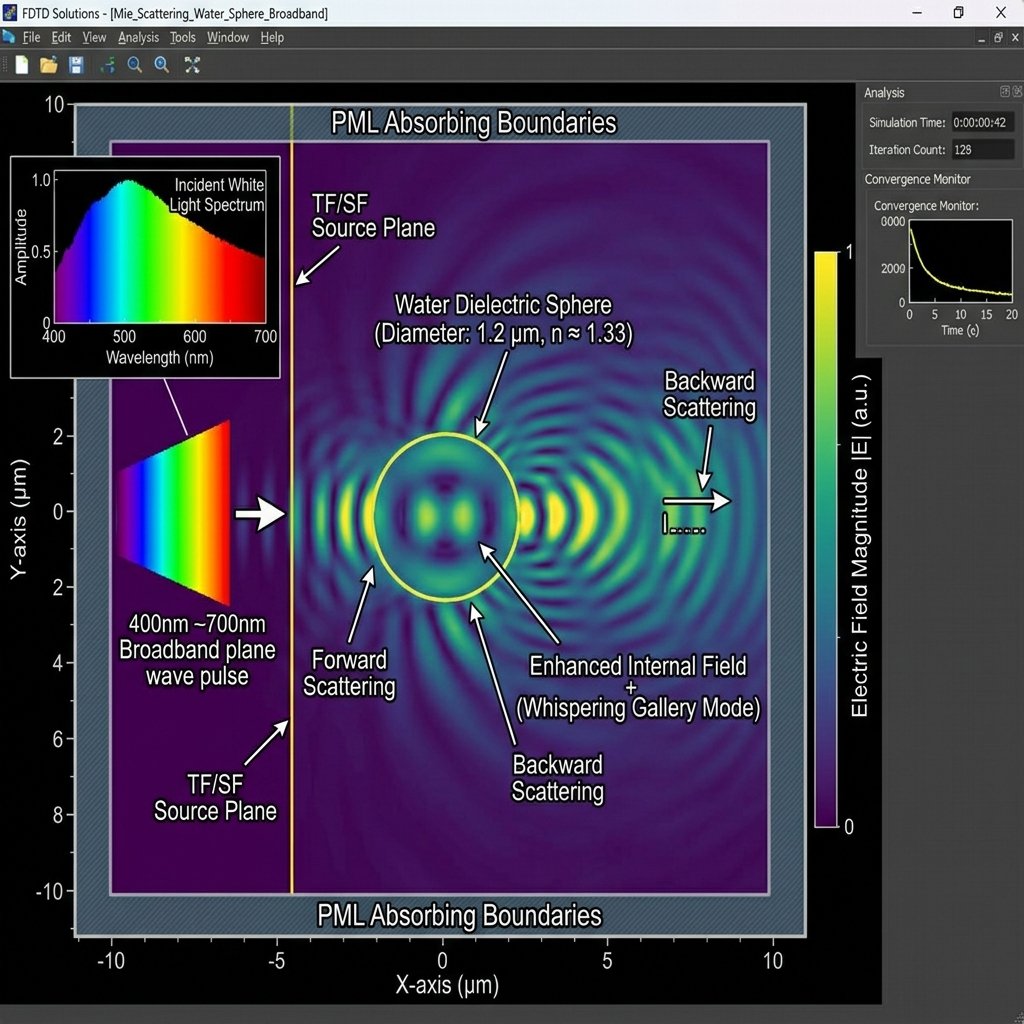
Figure 1: Preliminary generative visualization of white light scattering by a water dielectric sphere. This image was produced natively by Google Flow from a pure text prompt constraining it to standard 2D FDTD boundary conditions, without any visual reference provided. The model autonomously generated the interface layout, including all text labeling. The textual overlay appears to reverse the expected propagation labels. The varying intensity of the yellow pixels is reminiscent of periodic constructive and destructive interference. The exact time of the field for this output is not listed, only the total simulation time, leading to an indeterminate state regarding the consistency of the apparent propagation of the maximal pixel intensity region versus the curvature of the pixel intensity front. (Image generated via Google Flow)
Preliminary Visual Analysis of Generative Models prompted to generate FDTD Simulations
Recent exploratory tests constraining generative video models with standard FDTD boundary conditions (e.g., a dielectric sphere illuminated by white light) have yielded preliminary visual results that require further rigorous analysis. Convolutional, reservoir, and other types of neural networks are frequently chosen for simulating dispersive periodic phenomena. The formulation of gradient descent on these networks, when coupled with physical data, matches that of a variety of many-body problems in physics [1].
Because such systems naturally undergo oscillatory behavior—necessitating mechanisms like learning rate adaptation—this exploratory test of Google's generative video model yielded results that illuminate the need to develop a strict methodology. Specifically, we must inquire if measurable electromagnetic phenomena, such as Electric and Magnetic Dipole multipoles, are accurately preserved in the generated latent space. Future work will focus on extracting quantitative metrics from these generative outputs to compare against standard computational models.
References [1] Brunton, S. L., & Kutz, J. N. (2019). Data-Driven Science and Engineering: Machine Learning, Dynamical Systems, and Control. Cambridge University Press.